
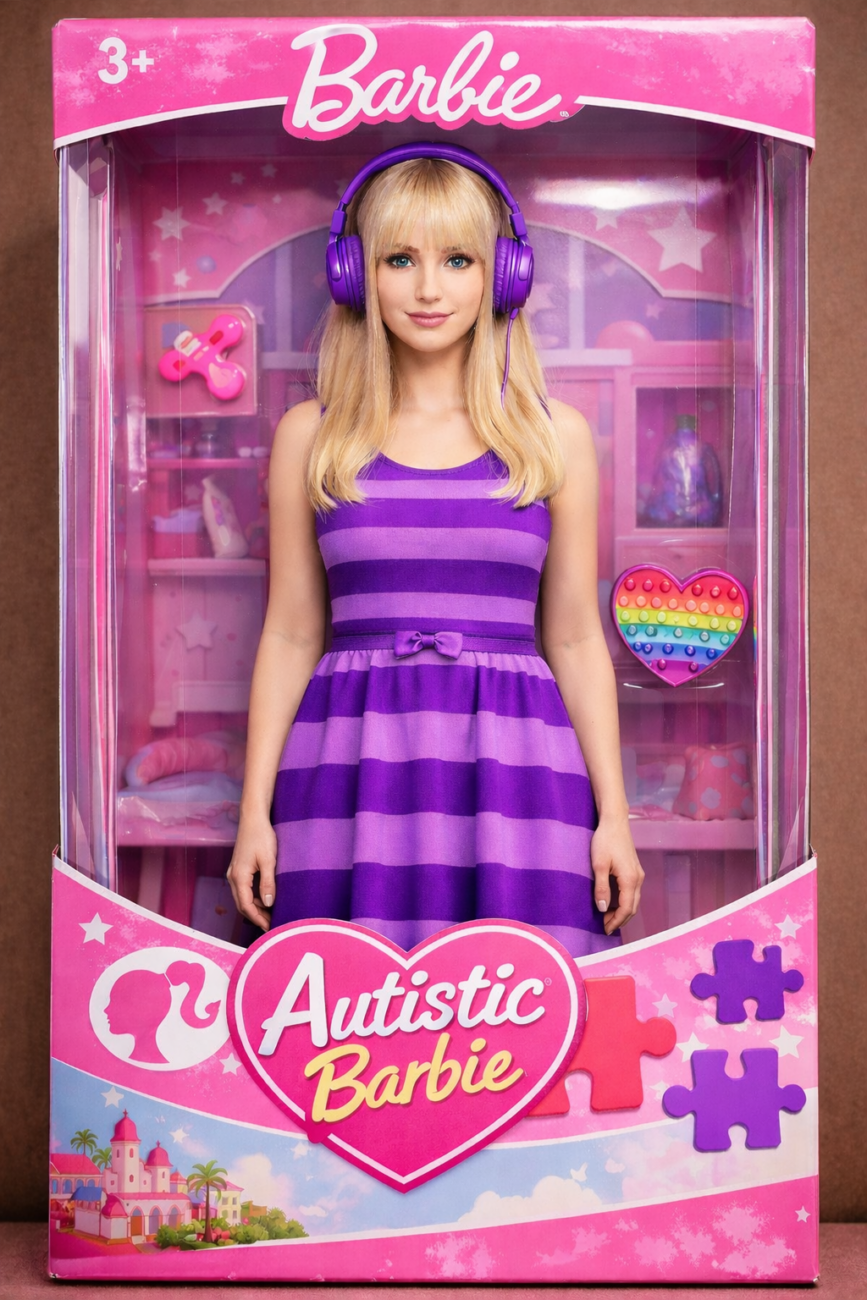
Move over Barbie doll in a pretty pink dress!
The global company, Mattel,™ has made a new Barbie doll to represent kids with autism spectrum disorder.
 The latest Barbie doll is said to “avoid eye contact.”
Don’t all dolls do that?
And that’s not all! “‘It comes with sensory tools such as a fidget spinner, noise-canceling headphones, and a communication tablet.” And wears a purple-striped dress.
According to Mattel, “Barbie has always strived to reflect the world kids see.”
What do kids see in a purple-striped dress?
According to AI, purple stripes in LGBTQ + flags, represents the asexual community as a whole. In gender identity flags, the purple stripe signifies a mix of male and female identities.
For those who prefer the androgynous look, there is the Transgender Barbie doll in the image of Laverne Cox. There are also barbies with vitillgo and hairless models.
The theme is all inclusive!
Autism Numbers Scattered
Since AI has taken over writing the news, the latest statistics appear to be all over the place.
The most recent data from 2012 reveals one out of every 36 children in America was diagnosed with autism. In 2018, that figure was one in 44. — PBS
Several sources give different statistics from the PBS version (above). One 2018 study suggested 1 in 39 kids was diagnosed with autism. In 2025, the CDC says at 1 in 31 kids with autism. A 2020 study suggested patterns of evaluation varied among different sites. That makes sense.
Different states have different rates. For instance, New Jersey says 1 in 33 kids with autism. In Colorado, it is 1 in 58. In Louisiana, 1 in 79.
Today, the experts claim, “there is no increase in autism.” Rather, it is reflective of “enhanced diagnosis” of brown and black children, as well as “being able to identify a few more people assigned female at birth.” [Did they admit to ignoring non-white children?]
 A decade ago, researcher, Dr. Stephanie Seneff projected that half of all U.S. children would be autistic by 2025 due to glyphosate exposure.
Thanks to AI research, taking all reporting into consideration, it is unclear whether autism is on the rise or the decline!
Autism would appear to be rising, since all reports claim it is more common than ever before.
Otherwise, why create an autistic doll?
Follow The Money
 Dr. Seneff’s estimate of rising autism rates mirrors the doubling of special ed students and classrooms over the last four decades.
And their rising costs. After all, when we follow the money, we often get a clearer picture.
In the 1999-2000 school year, the cost of $8,080 per pupil requiring special education services worked out to 21 percent of overall spending on public schools that year. In 2025, those numbers have grown with a recommended national budget increase of $14 billion for the cost of special ed pupils with directives on how states should allocate the money.
In Wisconsin, that means $30 million more to continue school-based mental health services statewide, more than $54 million to support high-cost special education needs, and $2 million to sustain the Department of Public Instruction’s operations.
The rising cost for special Ed funding in states means higher taxes for you!
Does that Barbie doll come with a large bank account?
The Global Common Good
 Is global government guilty of using a global company (Mattel) to pander to the lowest common denominator as a way of revaluing human capabilities toward a global Common Good?
Are we seeing a reset toward simplification, rather than putting things at a level that’s more suitable for the group as a whole?
Such is a global public education today.
The Cause?
As ever, the cause of autism spectrum disorder (ASD) remains elusive. In western medicine there is never a cause. So we have to put on our thinking caps to uncover the possibilities.
Is the cause of ASD related to glyphosate exposure in food, cow’s milk, honey, cereal, bread, Gatorade, beer, wine…? Is it glyphosate in vaccines? [the FDA knew of the link since at least 2016 thanks to an investigation by Moms Across America]. What about Aluminum in vaccines and other adjuvants that continue to be widespread? Is ASD related to Tylenol? Is it related to too many ultrasounds for the fetus in utero? Is it wireless devices and 5G?
Is ASD related to living in a toxic world?
Anything is possible. Remember when science blamed mothers as the cause of ASD, as Refrigerator Mother Syndrome?
The cause does not matter. What matters is the Barbie doll took 18 months to develop. Why did they report 18 months? What do kids see of the world at 18 months?
They can receive multiple doses of 18 different vaccines at 18 months*.
*Vaccine kit sold separately.







Leave A Comment