

The Adventures of Pinocchio was published in 1883 by Italian mason Carlo Colloidi, then later adapted into a film by Walt Disney, another mason.
The misadventures of Pinocchio is a spiritual story based on esoteric teachings through allegory. Behind the story of a wooden puppet is a boy who cannot control his destination (i.e., rebirth) because he is a slave to his passions.
In this story for children is the lesson of ‘not lying’ as a way to escape from a modern world full of traps. We see his rebirth as a human begin after a “mystical death” portrayed as his struggle in the belly of the whale for three days and three nights.
In our modern world, broken promises, self‑deception, rumors, exaggeration, fabrication, plagiarism, manipulation, and avoidance, are all forms of lies.
In 2026, we accept that we are surrounded by lies as normal. From the obvious bold-faced lie to the exaggeration of mixing truth with untruths, we never get the full truth.
Today, we have experts in body language and behavioral analysis paid to pick apart the liars; as if we are incapable of being our own analysts.
 Lies & Consequences
Most of us contrast lies as: intentional lies vs. white lies. But in doing so, do we justify a lesser evil?
By telling a white lie we have been taught that we do not cause harm. We justify the lie because we do not wish to hurt another’s feelings. But in actuality, we are showing disrespect for the relationship by putting up a roadblock to a deeper relationship.
In 1912, Rudolf Steiner said:
For the lie is the direct opposite of the actual facts and those who yield themselves lovingly to the facts are incapable of lying. The lie has its roots in egoism—always and without exception. (GA 143)
In 1913 (GA 246), Steiner talked about the biggest danger as self-deceit:
a person does not realize—when he tells a lie—that the greatest conceivable danger actually lies in store for him: namely, the danger of deceiving himself or impairing his other senses.
The danger that Steiner warned about is being lulled into a false sense of security which becomes significant between death and a new birth, when we lose the physical body. Since the force of a lie remains in the soul, it has to make amends in a future life—i.e., reincarnation.
This speaks to karma.
What we are not taught in life is that as the soul passes through death, nothing is erased of what a person has done on Earth. A new birth depends on the life we have lived here.
The Question of The White Lie
In the same lecture (GA 143), Steiner described the white lie:
Concealing something out of love, a white lie, is always a very complicated act. A white lie out of love may be a necessity; at first it may seem like a good deed, but in a very complicated way it creates a bond. Through the white lie, we have become karmically connected to the person concerned, and indeed we have connected ourselves to their weakness. We will have something to do with them again later.
In his lecture on Cosmology (GA 94), Steiner said lies on the physical plane can cause harm but they do not destroy anything, as they do on the astral plane where they are living forces. Specifically, he said:
A lie on the physical plane leads to destruction on the astral plane. A lie is murder on the astral plane. This phenomenon is the origin of black magic. The commandment on the physical plane—“Thou shalt not kill!”—can therefore be translated for the astral plane as: “Thou shalt not lie!”
From this understanding we come to the realization that the physical world is a product of the astral world.
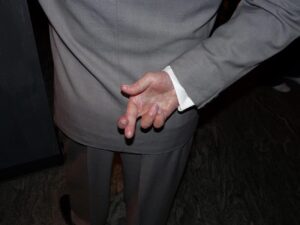
How You Can Tell When Someone Is Lying?
-
Inconsistent Stories
Liars can struggle to keep their stories straight. Contradictions and inconsistencies are common symptoms.
-
Body Language
Non-verbal cues, like avoiding eye contact and fidgeting are associated with deceit.
-
Changes in Vocal Pitch
A noticeable change in someone’s voice, such as sudden high-pitched tones or stammering, suggests anxiety, which could be linked to dishonesty.
-
Overemphasis and Defensiveness
Liars may overemphasize their statements or become defensive when questioned. Watch for defensive language, such as excessive use of “I swear” or “to be honest.”
-
Inappropriate Smiling or Laughing
A liar might smile or laugh at odd moments. It could mean they’re trying to diffuse tension or mask their discomfort.
-
Avoidance of Direct Answers
Liars often avoid giving direct answers to straightforward questions or change the subject entirely.
-
Changes in Blinking Patterns
Increased blinking or a sudden lack of blinking can be associated with anxiety, which could be because they’re trying to deceive you.
Final Thoughts
Rudolf Steiner passed along esoteric knowledge of our eternal nature through Spiritual Science, or Anthroposophy, defined as “the wisdom of the human being,” a wisdom meant to be lived.
Like Pinocchio who learned from his experiences to enter a new world, we are meant to prepare ourselves on Earth for the next world. Steiner encouraged us to carry within us the light that illuminates the spiritual world, stating:
We must have prepared this light here on earth; otherwise, we will see nothing in that spiritual world. So the person who believes they need not concern themselves here with spiritual and soul life enters the spiritual world at death like someone who walks into a dark room without bringing any light; they say, “Why should I turn on a light in the next room? I’ll see what’s in the dark room anyway.”
What, then, must we gain over there? The powers we must take with us into our new earthly life. We are born with certain abilities. What is passed down to us through heredity does not extend to every detail regarding the finer structure of the brain. You’d be quite surprised if you could see what a brain would look like if it possessed only its inherited traits (GA 246).











Leave A Comment